With the rapid development of global industrialization, environmental pollution is increasing dramatically, and the storage of non-renewable energy sources such as oil and coal is decreasing year by year. Therefore, finding a clean and renewable new source is a major and arduous task for human society. Solar energy is a renewable energy source; solar cells only need sunlight to generate electricity, making solar energy a very clean source of energy. Currently, solar cells have been applied in people's daily lives and some industries, making them a widely popular renewable energy source.
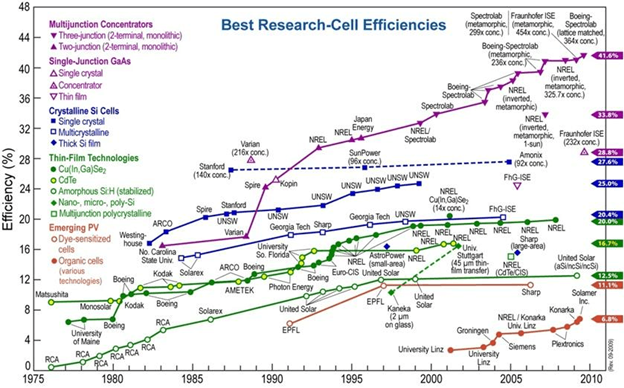
Most of the solar cells currently on the market are silicon solar cells. In 1954, the crystalline silicon solar cell was born, with an initial Power Conversion Efficiency (PCE) of about 6%. By 2020, the PCE had increased to around 26%, approaching the theoretical limit of 29% for silicon solar cells. Although perovskite solar cells' history is shorter than silicon cells, their efficiency has rapidly improved in recent years. As shown in Figure 1, the trend of solar cell efficiency growth reported by the National Renewable Energy Laboratory (NREL) of the United States shows that the PCE of perovskite solar cells has increased from about 14% in 2013 to around 26% in 2020. In addition, lamented cells composed of perovskite and silicon achieved a high PCE of about 29.5% in 2020. The growth rates of these two types of perovskite cells are significantly higher than others. Due to the enormous potential of perovskite in the solar cell industry, it has become a research hotspot in recent years.